Evaluating Mental Health Service Utilization and Mental Health Outcomes among Women in the Canadian Armed Forces
Evaluating Mental Health Service Utilization and Mental Health Outcomes among Women in the Canadian Armed Forces
Citation
HubkaRao T, Meaney C, Selvadurai S, et al. Evaluating Mental Health Service Utilization and Mental Health Outcomes among Women in the Canadian Armed Forces. CIMVHR Forum 2026. 2026 Oct 19-21. Halifax NS.
Abstract
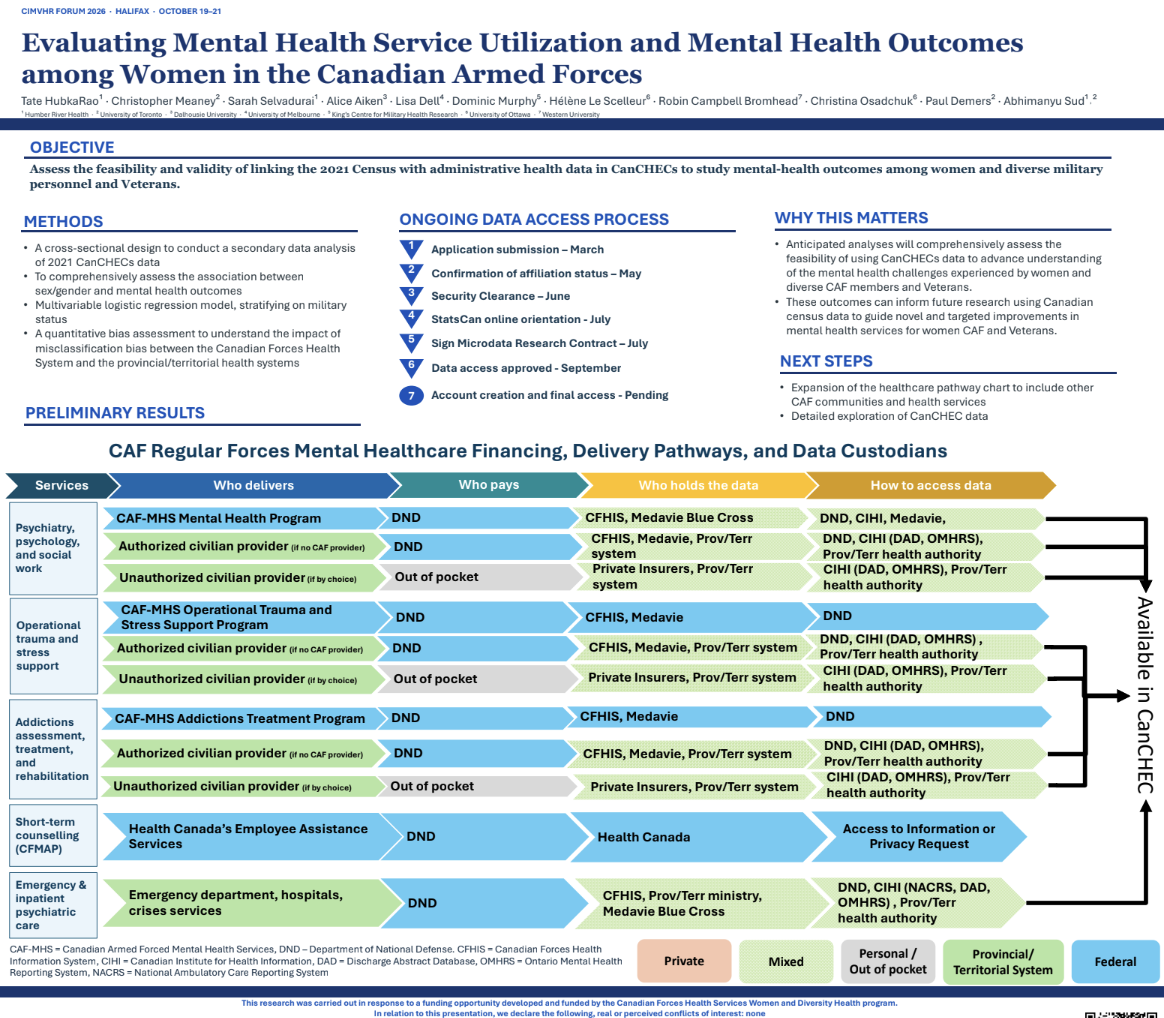
Introduction: There remains a lack of research focused on women in the Canadian Armed Forces (CAF), reflecting broader patterns of the persistent invisibility of women in Canada’s military and Veteran populations, and resulting in significant knowledge gaps surrounding their mental health and well-being. The proposed study aims to rigorously assess the feasibility and validity of linking the 2021 Canadian census to administrative health data within the CanCHECs dataset to advance understanding of mental health in women and diverse military personnel and Veterans.
Methods: We will use a cross-sectional design to conduct a secondary data analysis of 2021 CanCHECs data. We will use descriptive statistics to report respondent characteristics related to study outcomes (mental health related hospital admission, length of hospital stay, and emergency department visit), exposure (sex/gender), diversity factors (e.g., age, 2SLGBTQI+ status, race), and mental health risk factors (e.g., comorbidities, substance use), stratified by military status (active CAF member, Veteran, civilian) using frequencies and proportions with 95% Confidence Intervals (CI). To comprehensively assess the association between sex/gender and mental health outcomes, we will conduct a multivariable logistic regression model. For each outcome, we will estimate the adjusted association of sex/gender with mental health outcomes, stratifying on military status, after adjusting for potential confounding variables via odds ratios (ORs) alongside 95% CIs and p-values. Additionally, as the degree of misclassification bias between the Canadian Forces Health System and the provincial/territorial health systems is currently unknown due to limitations in available datasets, we will conduct a quantitative bias assessment to understand the impact of this bias on results from the CanCHECs dataset by assessing whether model inferences remain stable across simulated sensitivity values.
Results: Within the 2021 census (N = 29,527,350), approximately 99,020 Canadians self-report as currently serving members of the CAF (0.3%), within which 18,530 (18.7%) self-report as women and 13,785 (13.9%) self-report as a visible minority. Among Veterans (n = 461,240), 74,940 (16.2%) identified as Women+, and 19,130 (4.5%) identified as a visible minority. Additional analyses are pending.
Conclusions: Anticipated analyses will comprehensively assess the feasibility of using CanCHECs data to advance understanding of the mental health challenges experienced by women and diverse CAF members and Veterans. These outcomes can inform future research using Canadian census data to guide novel and targeted improvements in mental health services for women CAF and Veterans.
Project Team
Tate HubkaRao