Improving opioid use disorder care in primary care in Ontario
Improving opioid use disorder care in primary care in Ontario
Citation
Selvadurai S, Vinoth S, Sud A. Improving opioid use disorder care in primary care in Ontario. UofT DFCM Conference 2026, and CAHSPR Conference 2026. 2026 May 13, and 25-28. Toronto, and Ottawa ON.
Abstract
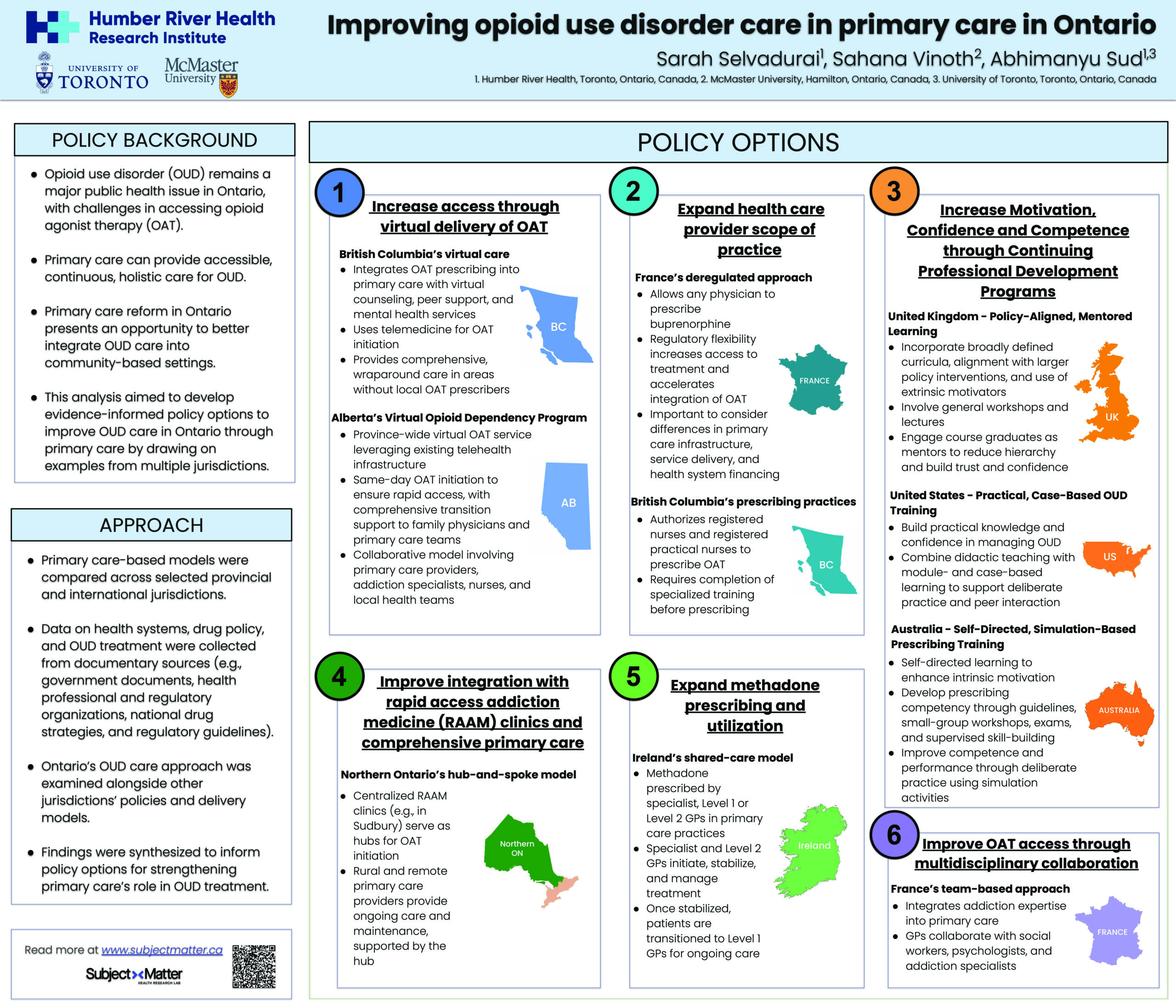
Background: Opioid use disorder (OUD) remains a significant public health issue in Ontario, with challenges accessing opioid agonist therapy (OAT). As Ontario advances primary care reform, there is an important opportunity to better embed OUD care within community-based settings.
Objective: To develop evidence-informed policy options to improve access to OUD care through primary care.
Methods: Based on policy analyses, primary care-based models for OUD treatment were compared across selected provincial and international jurisdictions. Data were drawn from documentary sources, including government documents, regulatory and professional guidelines, and national drug policies. Ontario’s current approach to OUD care was examined alongside models implemented in other jurisdictions to identify opportunities for reform.
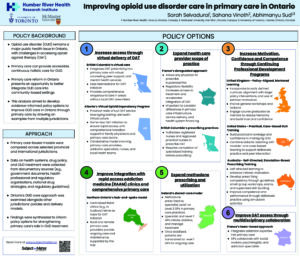
Results: Six policy options were identified. First, expanding methadone prescribing and utilization, informed by Ireland’s shared-care model, may improve treatment retention. Second, broadening provider scope of practice, similar to France and British Columbia, could build system capacity. Third, expanding virtual OAT delivery, drawing on Alberta and British Columbia, may improve access for rural and underserved populations. Fourth, integrating addiction expertise into multidisciplinary primary care teams, as seen in France, could enhance care quality. Fifth, strengthening integration between Rapid Access Addiction Medicine clinics and primary care through hub-and-spoke models can improve continuity of care. Finally, targeted continuing professional development programs, informed by the UK, Australia, and US, could increase provider motivation and confidence in managing OUD.
Conclusion: These policy options highlight opportunities to strengthen system capacity, reduce fragmentation, and support equitable delivery of OUD care as part of ongoing primary care reform.
Project Team
Sarah Selvadurai
Abhimanyu Sud